
Riley County Active Warrants
Riley County Police Department, often shortened to RCPD, is the first official contact point for local warrant safety guidance. Riley County does not use a normal sheriff-only website for countywide police work. Law enforcement is handled by the consolidated Riley County Police Department at 1001 S. Seth Child Road in Manhattan. The official RCPD warrants page warns the public not to detain a person or take action on their own when an active arrest warrant is suspected.
For public users, that means a Riley County warrant search is not just a name lookup. RCPD gives the main police number, 785-537-2112, and Crime Stoppers at 785-539-7777 for tips. The same official page says a person may turn themselves in at the Riley County Police Department day or night. That direct surrender option is important because online court records can lag behind real-time warrant status.
The official RCPD page is shown in the manifest image from the Riley County Police warrants source.
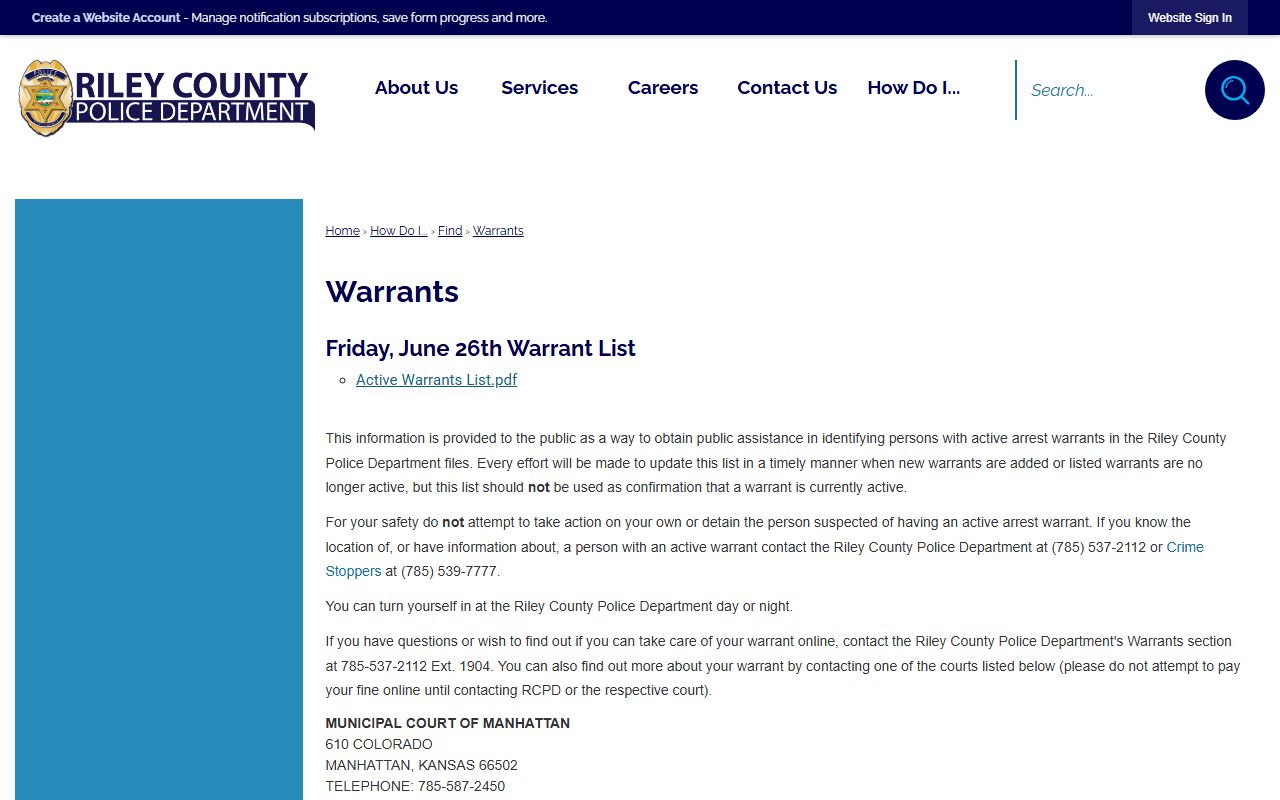
That source supports the main safety rule for Riley County warrant records: use official contact routes rather than trying to act on a suspected warrant yourself.
Riley County Warrant Search Channels
There is no researched public statewide Kansas warrant search that covers all active warrants for Riley County. A practical search uses several official channels because the warrant source depends on the case. Arrest warrants and some probation warrants may connect to a district criminal file. Bench warrants may appear in district or municipal court activity. Police records may confirm some public information, but active warrant disclosure can be limited.
- Start with RCPD if the issue is active law-enforcement status, safety, a tip, or surrender instructions.
- Search the Kansas District Court Public Access Portal for public Riley County District Court case activity tied to the person or case number.
- Use the courthouse public terminal or contact the Clerk of the Court at Riley County District Court for district-court procedure. Court staff will not search names by phone.
- Check Manhattan, Ogden, or Riley municipal court if the matter began as a city ticket, ordinance case, or municipal failure to appear.
- Use an RCPD records request for public police records when the request is about an arrest report, call record, or other law-enforcement file rather than real-time warrant clearance.
The fallback chain matters in Riley County because a court docket entry is not the same thing as a live agency confirmation. A warrant may be served, recalled, quashed, or entered before all public displays are updated. If paperwork lists an issuing court, use that court. If the only information is a tip about a person with an active warrant, use RCPD or Crime Stoppers.
Riley County Warrant Search Fields
Riley County research did not locate a single official web form with a public active-warrant name search. The fields below show the information a searcher should gather before using RCPD contact, Kansas CaseSearch, courthouse terminals, or municipal court contact. The same items are also useful when asking whether a warrant has been served, recalled, or tied to a pending court date.
| Field Label | Type | Required | Options / Format Notes |
|---|---|---|---|
| Subject name | text | yes | Use full legal name when known; common names should be checked against court, date, and agency details. |
| Case number | text | optional | Useful for district court or municipal court bench warrants and failure-to-appear matters. |
| Issuing court | court name | optional | Riley County District Court, Manhattan Municipal Court, Ogden Municipal Court, or Riley Municipal Court may be relevant. |
| Charge or underlying case | text | optional | Helps distinguish an arrest warrant from a bench warrant, probation violation, or municipal citation issue. |
| Date of birth | date / text | optional | Use only with official channels that request it; do not publish private identifiers. |
| Agency contact | phone / office | yes for confirmation | RCPD handles active local law-enforcement contact; courts handle court procedure and docket status. |
These fields also reduce false matches. Riley County warrant records can involve district criminal cases, traffic matters, municipal cases, or probation. Name-only search results should be read with care, especially when the case has a common name or old address.
Riley County Warrant Types
Warrant terms in Riley County records describe why the order exists and what agency or court controls the next step. An arrest warrant authorizes law enforcement to arrest a named person. A bench warrant is issued by a judge, often after a missed hearing, unpaid obligation, contempt issue, or other failure to comply with a court order. A search warrant is different because it authorizes a search of a place, device, or item, not the arrest of a person.
| Warrant Type | Common Riley County Source | What to Check |
|---|---|---|
| Arrest warrant | Law-enforcement investigation or filed criminal case | RCPD contact and the related district court case when public. |
| Bench warrant | Riley County District Court or a municipal court | Case docket, missed hearing, bond status, and recall order. |
| Failure to appear | District or municipal traffic and criminal cases | Issuing court, payment status, next appearance, and bond terms. |
| Probation violation | District court and court supervision activity | Case number, supervising office, warrant status, and next hearing. |
| Search warrant | Judge-approved investigation step | Disclosure may be limited, especially before execution or while an investigation is active. |
Riley County Warrant Record Fields
When a Riley County warrant record is public, the available details are usually narrow. A public court case may show that a warrant was issued, returned, recalled, quashed, or tied to a missed hearing. A police or court contact may be needed to confirm active status. The field inventory below follows the warrant fields identified in the Riley research.
| Field | What It Shows |
|---|---|
| Subject name | The person named in the warrant or warrant-related court event. |
| Warrant type | Arrest, bench, failure to appear, probation violation, contempt, fugitive hold, or similar label. |
| Case number | The district or municipal court file connected to the warrant when one is public. |
| Issuing court | Riley County District Court or the municipal court that issued the order. |
| Charge or offense | The alleged offense, citation, violation, or court obligation tied to the warrant. |
| Bond amount | Bond set by the court, or a no-bond status if that is the court's order. |
| Date issued | The date the warrant was entered or signed, if public. |
| Status | Active, served, recalled, quashed, expired, or another court or agency status. |
The Kansas warrant statute image comes from K.S.A. 22-2410, which is relevant when warrant papers, sworn testimony, and active materials are not fully open.
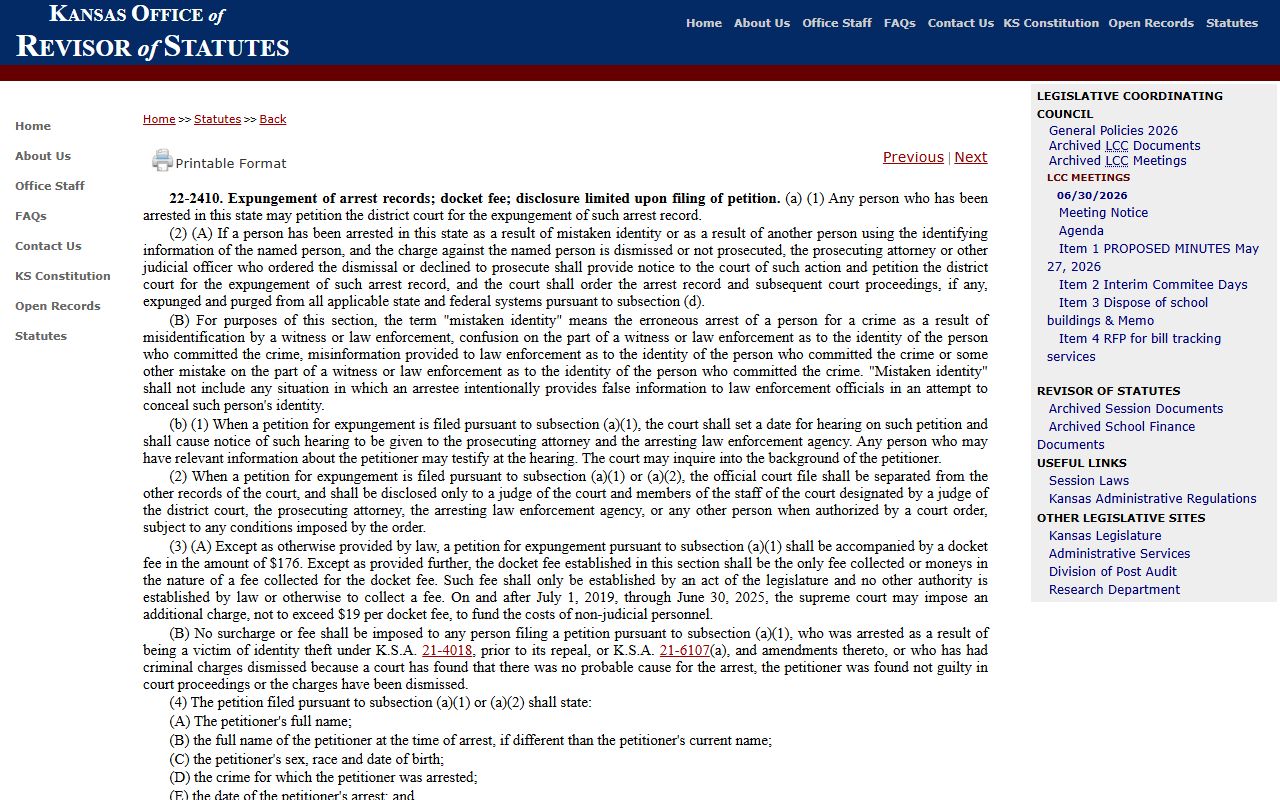
The statute source is a reminder that a public case entry may exist while affidavits, testimony, or investigative warrant material remain restricted.
Riley County Bench Warrants
Bench warrants in Riley County can come from more than one court. Riley County District Court handles district criminal, traffic, probation, and other case types at 100 Courthouse Plaza. Municipal matters can stay with Manhattan Municipal Court, Ogden Municipal Court, or Riley Municipal Court when the underlying case is a city ordinance or city traffic citation. A failure to appear in the wrong court cannot be cleared by calling a different office.
For district cases, the Kansas public portal and courthouse terminals are the better record route. For municipal cases, check the city court listed on the ticket, notice, or payment record. Manhattan's municipal citation portal and court fine page are separate from Riley County District Court. If a person has papers from one court and a warrant contact from RCPD, both the court and law-enforcement side may need to be addressed.
Note: CaseSearch and docket records help identify public court activity, but RCPD is the safer source for real-time active-warrant handling.
Clear a Riley County Warrant
Do not ignore a Riley County warrant and do not rely on unofficial databases. The right first call depends on the source. If RCPD is the agency contact, use the police number for surrender and safety questions. If paperwork lists Riley County District Court, call the court for procedure, next dates, bond questions that court staff may answer, and whether a court appearance is required. Court staff cannot give legal advice.
- Identify the issuing court, agency, case number, and charge or citation if those details are available.
- Call RCPD for law-enforcement surrender questions or active-warrant safety concerns.
- Call Riley County District Court at 785-537-6364 for district court procedure if the warrant is tied to a Riley district case.
- Call Manhattan, Ogden, or Riley municipal court if the matter is a city case or municipal failure to appear.
- Ask whether bond is set, whether a walk-in appearance is allowed, and how the court confirms a recalled or quashed warrant.
- After the issue is resolved, verify that the issuing court and agency systems have updated the warrant status.
Important: RCPD says people may turn themselves in day or night, but legal advice should come from counsel, not police or court staff.
Warrants and Custody Status
Kansas VINE and VINELink are useful after custody status becomes the issue. They are not the same as a Riley County active warrant database. The RCPD VINE page links custody-status search and notifications, and the toll-free Kansas VINE number is 866-574-8463. Victims and other users may register for telephone and email alerts when a custody status changes.
The manifest image from VINELink shows the custody-status system that supports notification after a person is in custody or otherwise listed in the service.
Use VINE for custody alerts and RCPD or the issuing court for active warrant questions, because the two systems answer different questions.
Restricted Riley County Warrants
Kansas open-records law starts with a broad public policy, but Riley County warrant records are not all public in the same way. K.S.A. 22-2410 and KORA exemptions may limit release of sworn testimony, affidavits, search-warrant details, juvenile warrant information, sealed case material, and active investigative records. A case entry may be visible while supporting documents are not.
Riley County Police Department records requests can be used for public police records, but active warrant disclosure may be limited. RCPD Records accepts requests in person, by mail, fax, or email and states that it responds by the close of the third business day following receipt under the Kansas Open Records Act. A denial should give the reason for denial.