
Riley County Arrest Records and Charges
Riley County arrest records start on the law-enforcement side. Riley County Police Department is the consolidated county and city police agency, and RCPD records can include police reports, arrest reports, call records, local criminal-history or background-check information, and related public records when disclosure is allowed. Jail custody information is separate and is handled through the Riley County Jail information line.
Charges after arrest start on the prosecution and court side. The Riley County Attorney's Office is responsible for prosecuting criminal cases that occur in Riley County, including adult and juvenile criminal cases, Child in Need of Care matters, involuntary commitments, and traffic cases. Police arrest or booking does not by itself create a district-court criminal case. A court charge record begins when charges are filed or when case activity is opened in Riley County District Court.
The RCPD Records image comes from the Riley County Police Records page, the main local route for law-enforcement records requests.
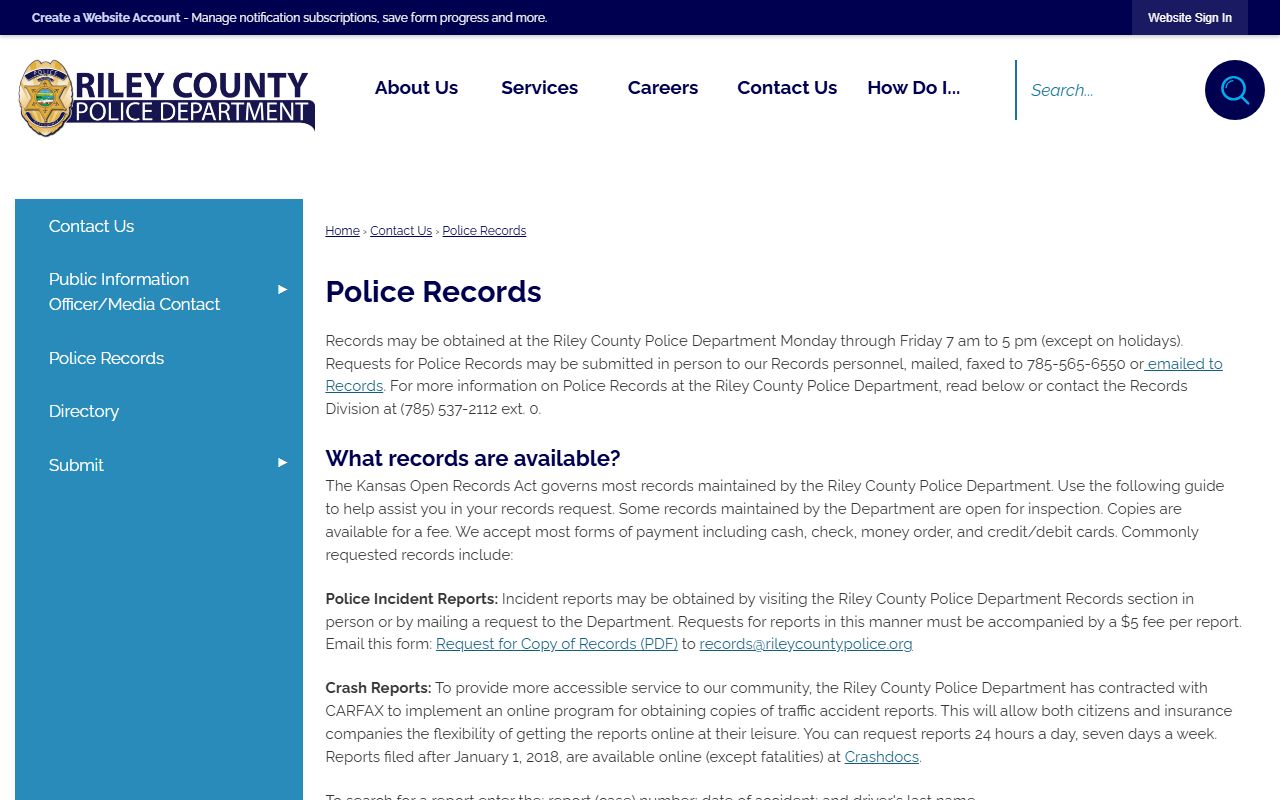
That source supports the arrest-record side of the pathway, while the district court record shows filed court charges, hearings, and outcomes.
Riley County Arrest vs Charge Records
The key distinction is timing and source. An arrest record reflects police action, booking, custody, or a records request. A charge record reflects the prosecutor's formal allegation and the court file that follows. One arrest can lead to no filed charges, one filed charge, or several counts. Filed charges can later be amended, reduced, dismissed, or resolved by plea or trial.
| Record Type | Primary Source | What It Usually Shows | Best Riley County Channel |
|---|---|---|---|
| Arrest record | RCPD and jail records | Police event, arrest report, booking or custody facts when public. | RCPD Records, jail information, or Kansas VINE for custody status. |
| Court charge record | Riley County Attorney and District Court | Filed count, statute, severity, bond, case number, hearing activity, and status. | Kansas District Court Public Access Portal or courthouse public terminal. |
| Criminal case file | Clerk of the Court | Charges, pleadings, motions, docket entries, disposition, and sentencing. | Riley County District Court records route. |
For custody and booking detail, use the Riley County inmate search route. For the full case file after charges are filed, use Riley County criminal court records. Keeping the sources separate helps avoid treating an arrest as a conviction.
Find Riley County Arrest Records
A complete Riley County arrest records search uses both law-enforcement and court sources. RCPD Records accepts public records requests Monday through Friday from 7 a.m. to 5 p.m., except holidays. Requests may be submitted in person, by mail, by fax, or by email. Court charges are searched through the Kansas District Court Public Access Portal or a public terminal at Riley County District Court.
- Use RCPD Records for police reports, arrest reports, local background checks, and other law-enforcement records when public.
- Call Riley County Jail at 785-537-2112 ext. 1902 for inmate information if the person may still be in local custody.
- Search the Kansas District Court Public Access Portal by name or case number for filed district court charges.
- Use the courthouse public terminal at Riley County District Court when the public portal does not show the needed record.
- Check the daily docket if the immediate need is a hearing date rather than the full case file.
The official Request for Copy of Records and background check form explains the request channels, including mail, fax, email, and in-person submission, plus the Kansas Open Records Act response timing.
Riley County Arrest Request Fields
RCPD records requests are the strongest local route for arrest-side records when a public law-enforcement record is needed. The form and records page identify the department address, records contact, fax, email, and KORA response practice. The form is not a live search portal, so accurate identifying information matters.
| Field or Contact | Type | Required | Riley County Notes |
|---|---|---|---|
| Requester contact details | text / contact | yes | Needed so RCPD can respond to a records request or denial. |
| Subject name | text | yes when known | Use full name to reduce false matches in arrest or background records. |
| Incident or case detail | text | optional | Date, location, report number, or incident facts help records staff locate the file. |
| Submission method | in person / mail / fax / email | yes | RCPD lists all four channels for records requests. |
| Records contact | phone / email | as needed | 785-537-2112 ext. 0, fax 785-565-6550, records@rileycountypolice.org. |
| Response timing | KORA response | required by law | RCPD states it responds by close of the third business day following receipt. |
Riley County Charging Documents
After an arrest, the Riley County Attorney decides whether to file formal charges. The charging document is the bridge between arrest records and court charges after arrest. In a Riley County District Court case, that filing gives the case a court setting where the charge, count, statute, severity level, bond, and early hearings can be tracked through public records when not restricted.
| Document | Filed By | Common Use | What It Starts |
|---|---|---|---|
| Complaint | Prosecutor, often based on police facts | Common first charging paper for criminal cases. | Formal court accusation and first case activity. |
| Information | Prosecutor | Formal prosecution document in many felony or misdemeanor cases. | The charge list that moves through arraignment and later hearings. |
| Indictment | Grand jury | Less common route for serious matters when a grand jury is used. | Formal accusation returned by a grand jury. |
The Riley County Attorney is Barry Wilkerson. The office is at 105 Courthouse Plaza in Manhattan, phone 785-537-6390, and the official county material says the elected County Attorney prosecutes criminal cases that occur in Riley County.
Riley County Charge Status
Charge status changes as the case moves. A charge may be pending at first appearance, amended after review, reduced through plea negotiation, dismissed by the court, or resolved by plea or trial. Riley County court records can also show warrants, bond orders, preliminary hearings, arraignment, motions, disposition, sentencing, probation, restitution, or revocation filings.
| Status | What It Means in a Court Charge Record |
|---|---|
| Pending | The charge has been filed and has not reached final disposition. |
| Amended | The prosecutor or court record changed the filed charge, count, or allegation. |
| Reduced | The charge was changed to a lesser count or lower severity as part of case activity. |
| Dismissed with prejudice | The charge ended and generally cannot be filed again in the same way. |
| Dismissed without prejudice | The charge ended but may be refiled if legally allowed. |
| Convicted | A plea or verdict established guilt on that charge or a changed charge. |
| Acquitted | A verdict found the defendant not guilty on that charge. |
Note: The Riley County court docket is useful for hearing dates, but the full case record is better for charge status and final disposition.
Riley County Charges vs Convictions
Riley County court charges after arrest are allegations. A conviction is a later court outcome based on a guilty plea, no-contest plea accepted by the court, or trial verdict. Public users should read each count separately because one arrest can have several charges with different results. A case may show a dismissed count and a conviction on a different count.
| Point of Comparison | Charge | Conviction |
|---|---|---|
| Stage | Filed accusation after arrest or investigation. | Final or later finding based on plea or verdict. |
| Proof level | Based on probable cause and prosecutor review. | Requires proof beyond a reasonable doubt or a valid plea. |
| Record wording | May show pending, amended, dismissed, or reduced. | May show guilty, no contest, sentenced, probation, or judgment entry. |
| Background use | Should not be described as guilt. | May carry legal penalties, sentence, and collateral effects. |
The RCPD FAQ image comes from the Riley County Police frequently asked questions source, which includes local criminal-history request methods.
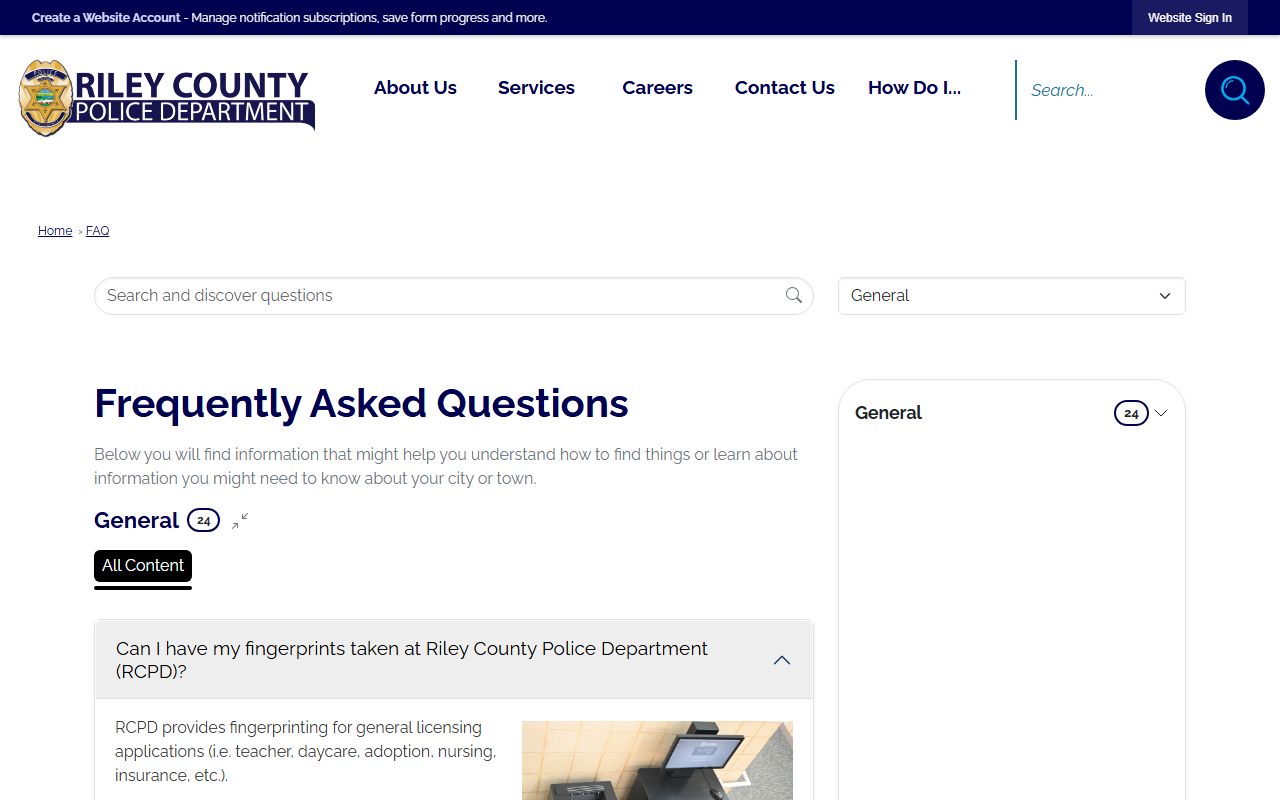
That FAQ source supports the difference between local law-enforcement background checks and the court case file that shows filed charges and outcomes.
Riley County Charge Access Laws
Kansas public-records law starts with K.S.A. 45-216, which states the broad policy that public records are open unless otherwise provided. K.S.A. 45-218 sets response duties and timing for public records requests. K.S.A. 45-221 lists categories that are not required to be disclosed, including records restricted by law, privileged records, and medical or treatment records.
For court charge records, K.S.A. 22-4701 is also important because it defines criminal history record information and notes that public judicial proceeding records are not the same as repository criminal-history data. That distinction matters in Riley County. A court case file may be public through the District Court Public Access Portal or a courthouse terminal, while criminal-history reports are separate law-enforcement or KBI records.
The RCPD contact image comes from the official Riley County Police contact page.
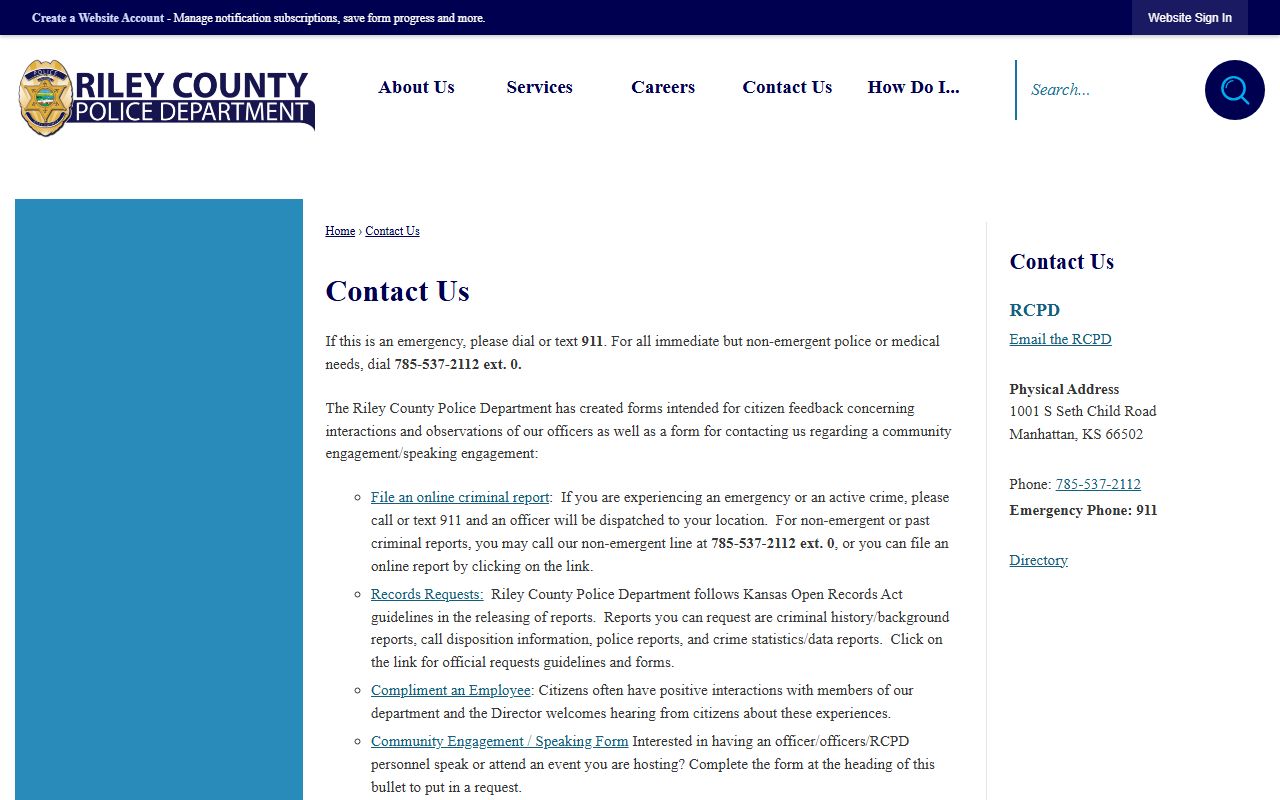
That contact source helps route arrest-record requests to RCPD rather than to the court clerk when the record is a police file.
Statewide Riley County Charge Checks
Statewide tools can help, but they answer different questions. The Kansas Bureau of Investigation public site links the registered offender search and information-services resources. The KBI registered offender website is for sex, violent, and drug offenders under Kansas registration law. It is not a complete list of Riley County arrests, active charges, or convictions.
KDOC KASPER is also separate. It covers people sentenced to Kansas Department of Corrections custody since 1980, including current incarceration, post-incarceration supervision, and discharged sentence statuses. It does not replace Riley County Police records, Riley County Jail information, or Riley County District Court charge records.
The KBI registry image is assigned from the Kansas Bureau of Investigation registered offender website.
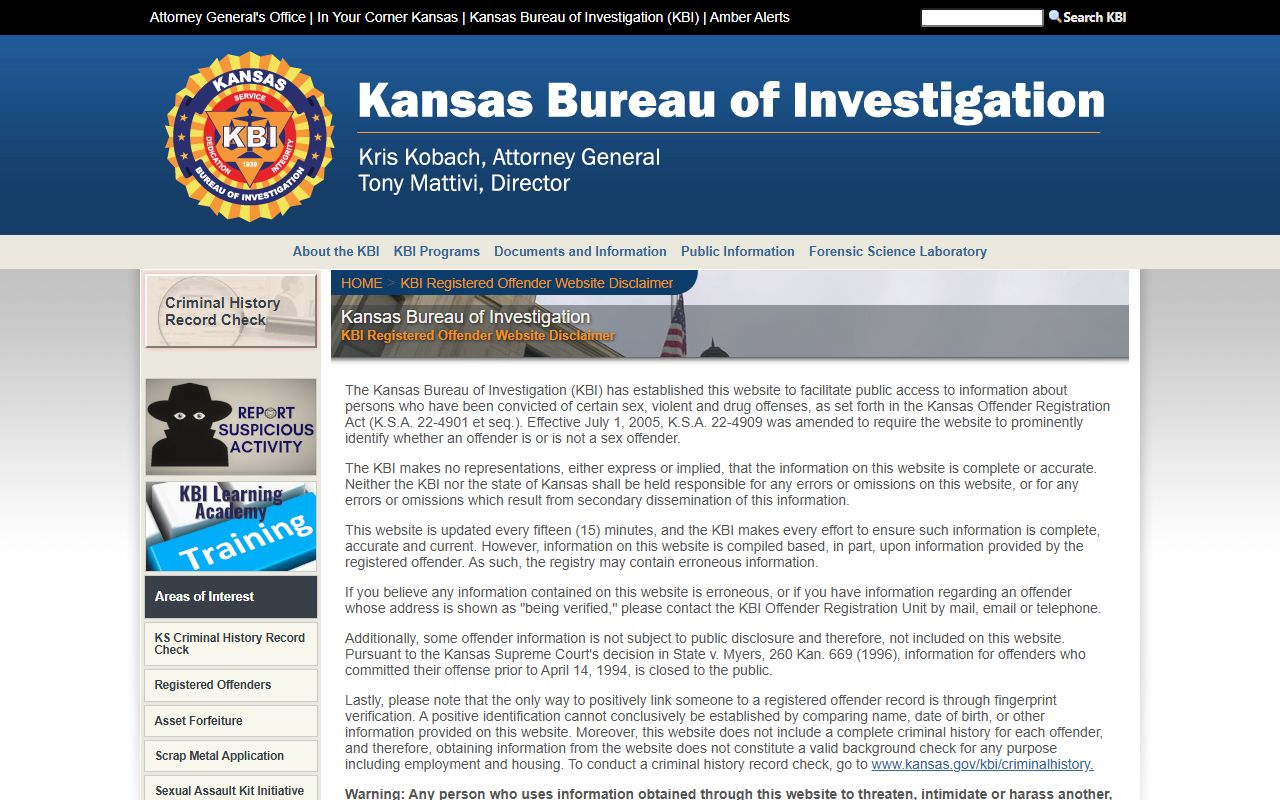
The KBI image belongs in this statewide section because registration status is a specialized public record, not a general arrest or court-charge database.
Restricted Riley County Arrest Records
Not all Riley County arrest records or charge records are open in full. Juvenile court records have special disclosure rules under K.S.A. 38-2309. Sealed cases and expunged criminal records under K.S.A. 21-6614 are not treated like ordinary public records. Medical, mental-health, victim identity, protected address, Social Security number, financial account, and minor information may be redacted or withheld.
Expungement should not be described as erasing every trace of a record. It changes ordinary public access and disclosure obligations, with exceptions. A person trying to clear a Riley County criminal record should identify the exact case number, charge, disposition date, and court, then review Kansas expungement rules and file in the court that handled the case if eligible.
Riley County Arrest Safety Tools
RCPD promotes public-safety communication tools that are not arrest databases. The department links P3 tips for Crime Stoppers and promotes what3words for emergency location. The what3words tool assigns three unique words to every 3-meter square, which can be texted to 911 so dispatchers can locate a caller. This can matter during an emergency, but it is not a court charge lookup.
The what3words image comes from the RCPD what3words emergency-location page.
That source is useful because it shows the public-safety side of RCPD, while arrest records and court charges still require records and court channels.
Riley County Background Checks
RCPD's FAQ says criminal-history requests may be submitted in person, by mail, by fax, or by email, and the Riley County application and background check cost located in the research is $10. A local background check is not the same as a certified court disposition or a statewide criminal-history repository result. For exact charge disposition, use the court record.
Important: Do not use casual arrest or charge lookups for employment, tenant, credit, insurance, or other FCRA-regulated decisions.