
Riley County Criminal Court Records
A criminal court record in Riley County is the court-maintained file for a prosecution. The file begins when charges are filed in court, not merely when police make an arrest. Riley County District Court is the primary trial court for felony and misdemeanor criminal matters filed under Kansas law, and it is part of the 21st Judicial District with Clay County. The Riley County Attorney prosecutes adult and juvenile criminal cases that occur in Riley County, along with traffic and other matters assigned to that office.
The full criminal court record is broader than a charge list. It may include the complaint or information, bond orders, first appearance, preliminary hearing entries, arraignment, motions, hearing notices, docket events, plea papers, trial results, disposition, sentencing journal entry, probation orders, restitution, warrants, and revocation filings. For a closer look at the arrest-to-charge path, use the Riley County arrest records and court charges page. For all case types, use the broader Riley County court records path.
Search Riley County Criminal Court Records
The online starting point is the Kansas District Court Public Access Portal. The portal supports searches by record or case number, party name, business name, attorney name, and attorney bar number. For criminal court records, the defendant name and exact case number are the most direct inputs. Search results should be checked against Riley County, case type, filing date, party role, and judge or division before relying on a match.
- Open the Kansas District Court Public Access Portal and accept the user agreement.
- Search by defendant name or by the exact criminal case number if it is known.
- Confirm that the case is a Riley County District Court criminal matter, not another county or municipal case.
- Review docket entries for charges, hearings, pleas, disposition, sentencing, warrants, and revocation activity.
- Use the courthouse public terminal or the Clerk of the Court for public records that are not fully visible online.
Riley County court staff will not search by phone, so the phone line is for procedural questions and routing. If the question is active custody, call or use jail and VINE channels instead of treating the court record as a live jail roster. If the question is an active warrant, court docket data may help, but law-enforcement status must be confirmed through the issuing agency or court.
The Riley County criminal and traffic page is the local source for appointed defense routing.
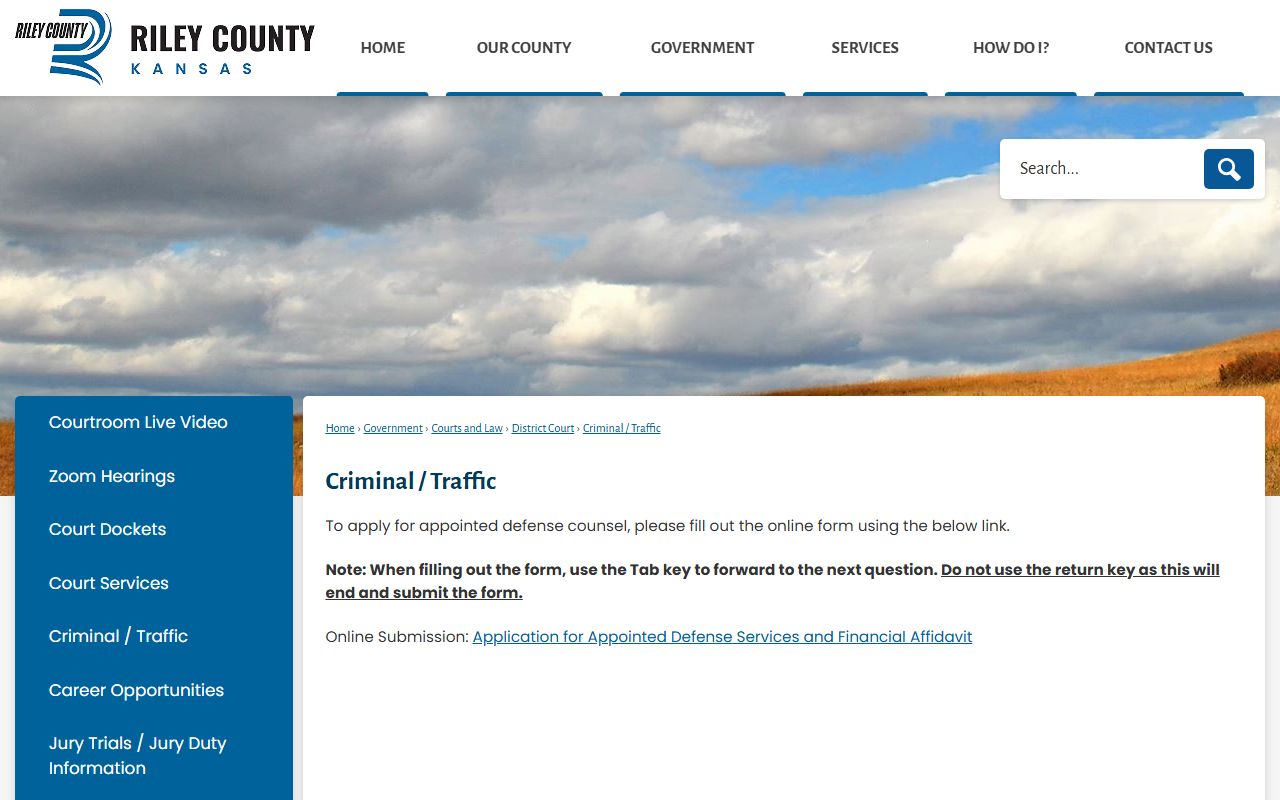
That image is useful because appointed-defense access is part of the local criminal case process once a defendant faces filed charges.
Riley County Criminal Case Flow
Criminal court records make more sense when read in case order. A charge can appear early and later be amended, reduced, dismissed, or resolved by plea or trial. A defendant may have bond conditions, multiple hearings, continuances, motions, and a sentencing entry. Docket entries are the map. Filed documents and journal entries are the formal record of what the court did.
Case flow: Charges Filed › Arraignment › Pretrial / Motions › Plea or Trial › Disposition › Sentencing
| Stage | What the Criminal Court Record May Show |
|---|---|
| Charges Filed | Complaint, information, statute citation, charge count, severity level, and case number. |
| Arraignment | The charges are addressed in court and a plea is entered. |
| Pretrial / Motions | Defense and prosecutor requests, orders, continuances, discovery disputes, or suppression issues. |
| Plea or Trial | A guilty, not guilty, or no contest plea, or a trial result. |
| Disposition | The outcome for each count, such as conviction, dismissal, acquittal, or amended charge result. |
| Sentencing | Sentence, probation terms, jail or prison term, fines, court costs, restitution, and conditions. |
What Riley County Criminal Records Show
A Riley County criminal court record can include both case-level and charge-level data. Case-level data identifies the court, judge, case number, parties, attorney information, and docket entries. Charge-level data identifies the offense alleged, count number, statute, severity, plea, disposition, and sentence. The key is to read each charge through to its final outcome because one case can contain several counts with different results.
| Field | What It Shows |
|---|---|
| Case Number | The Kansas or legacy identifier for the criminal court case. |
| Defendant | The person charged in the court case, usually in a State of Kansas caption. |
| Prosecutor | The prosecuting authority, commonly the Riley County Attorney for local cases. |
| Charges | Filed counts, statute references, offense names, and severity information when public. |
| Plea | Guilty, not guilty, no contest, or other plea activity shown in docket entries. |
| Motions | Requests filed by the defense or prosecutor and related court orders. |
| Disposition | Outcome for the case or each charge, including dismissal, conviction, acquittal, or amendment. |
| Sentence | Probation, custody, fines, costs, restitution, conditions, and revocation filings when applicable. |
Riley County Charges vs Convictions
A charge is an accusation filed in court. A conviction is an outcome after a guilty plea, no contest plea accepted by the court, or guilty verdict. Riley County criminal court records may show charges that were later dropped, amended, reduced, dismissed, or resolved in a way that is not a conviction. That is why a docket should be read from the filing stage through final disposition and sentencing.
| Point | Charge | Conviction |
|---|---|---|
| Meaning | An allegation filed in court. | A legal outcome based on plea or verdict. |
| When it appears | Early in the criminal case. | After plea, trial, or other final disposition. |
| What to check | Count, statute, severity, and amendments. | Disposition, sentencing entry, and any later revocation activity. |
| Risk of misread | Can be mistaken for proof of guilt. | Can be missed if only the first docket entries are read. |
Note: A criminal charge in a Riley County court record is not the same thing as a conviction.
Riley County Criminal Records Access
Kansas law starts with a public-records policy, but criminal court records are not unlimited. K.S.A. 45-216 states Kansas public policy that public records are open unless otherwise provided. K.S.A. 45-218 addresses response timing and refusals for records requests. K.S.A. 45-221 lists records that are not required to be disclosed, including protected and privileged categories.
Criminal-history repository records are a separate category. K.S.A. 22-4701 defines criminal history record information and helps explain why a public judicial case file should not be confused with a police background-check response. Riley County criminal court records come from the court file. Police reports, local background checks, and arrest reports route through the Riley County Police Department records process when public and available.
The Kansas Bureau of Investigation public site is one assigned source for criminal court record context.
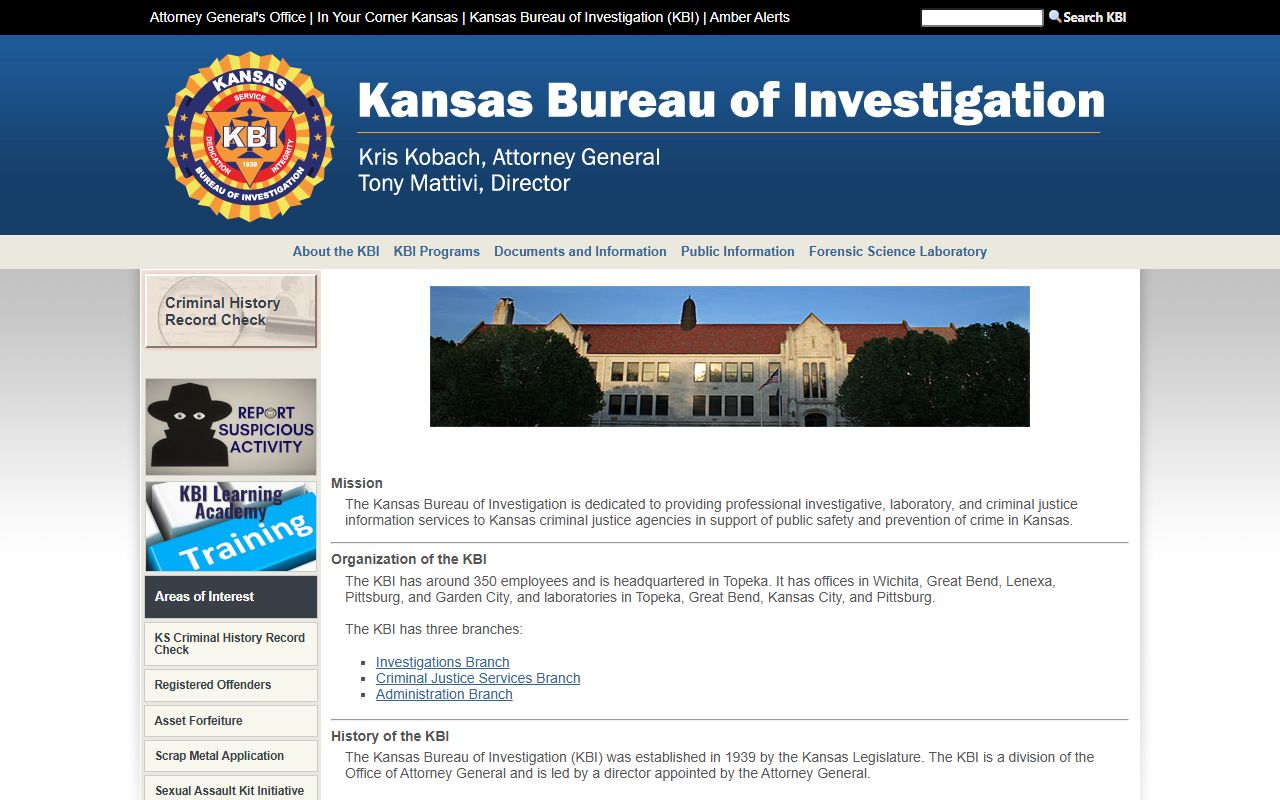
The image supports the distinction between a court case search and state-level criminal justice information maintained outside the Riley County court file.
Riley County Sealed and Expunged Records
Sealed and expunged are not the same. A sealed record is closed from public view by law or court order. An expunged Kansas criminal record is removed from ordinary public access after a judge grants relief under the expungement statute, but the research warns against saying expungement erases everything. Exceptions can remain for law enforcement, licensing, later proceedings, and other statutory uses.
| Point | Sealed | Expunged |
|---|---|---|
| Main effect | Closed from public view by law or court order. | Removed from ordinary public access after eligible relief is granted. |
| How it happens | By statute, court rule, or judge's order. | By petition and order under Kansas expungement law. |
| Public search result | May be hidden or limited. | Should not appear like an ordinary public criminal case result. |
| Exceptions | Access may remain for listed parties or court-authorized users. | Law-enforcement and statutory exceptions may remain. |
A practical Riley County expungement review starts with the exact case number, charge, disposition date, and court. Use the Kansas portal or courthouse terminal if the case is still public. Then review K.S.A. 21-6614 and file in the court that handled the case when eligible. Expect notice to prosecutors and possibly law-enforcement agencies.
The manifest includes the Kansas expungement statute for this criminal court records page.
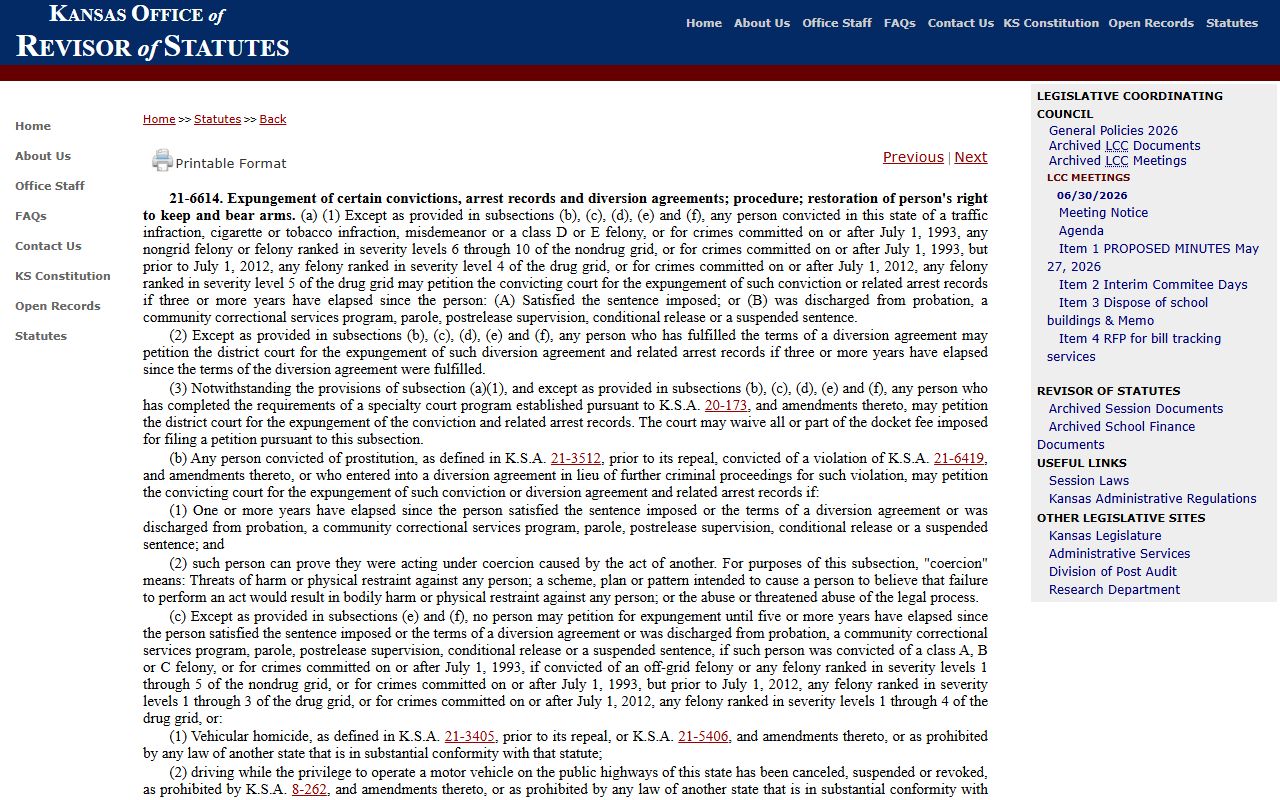
That statute image belongs here because expungement is the main legal route for changing ordinary public access to eligible Kansas criminal records.
Restricted Riley County Criminal Records
Some Riley County criminal court records or related records are restricted from ordinary public access. Juvenile matters have special disclosure rules under K.S.A. 38-2309. Victim identity information, social files, reports, and juvenile service information can be protected. Active warrants, sworn testimony, and certain warrant materials can have disclosure limits, especially before execution. Medical, mental-health, and treatment information can also be withheld under Kansas public-records exemptions.
Protection order details, protected addresses, Social Security numbers, financial account numbers, minor names, and victim identifiers may be redacted even when the case itself has public activity. If the public portal does not show a Riley County criminal court record, that does not always mean no case exists. It may mean the case is sealed, restricted, too new, too old, outside the portal, municipal rather than district court, or federal rather than state court.
Riley County Criminal Court Offices
Three local offices often touch a Riley County criminal case, but they do different work. The Clerk of the Court maintains the court case file and public terminal access. The Riley County Attorney prosecutes criminal cases that occur in Riley County. The Riley County Police Department handles police records, arrest reports, local background checks, jail information, and law-enforcement records requests. Mixing these offices can slow a search.
Riley County Clerk of the Court
100 Courthouse Plaza
Manhattan, KS 66502
785-537-6364
Clerk hours: Monday-Friday, 8:00 a.m.-5:00 p.m.
Riley County Attorney
105 Courthouse Plaza
Manhattan, KS 66502
785-537-6390
County Attorney Barry Wilkerson is listed as the elected prosecutor.
For appointed-defense applications, the Riley County criminal and traffic page directs applicants to the online appointed defense form and notes that the Tab key should be used to move through the form. For police records or a local background check, RCPD records accepts requests in person, by mail, fax, or email and states it responds by the close of the third business day following receipt under KORA.