
Riley County Probate Records
Probate in Riley County is not handled by a separate county probate court. The State Court Structure Map identifies the local probate forum as the Probate Division of District Court, and the Riley County District Court page lists probate and administration of estates, guardianships, conservatorships, and care of the mentally ill among local district-court case types. The Clerk of the Court contact block also lists Probate under the departments handled by the clerk. That means probate filings, copy requests, and public-terminal searches route through Riley County District Court at the courthouse.
Probate records can be narrow or broad. A simple estate may involve a petition, appointment order, notices, letters, inventory, and closing order. A guardianship or conservatorship may continue for years with annual reports, accountings, medical or financial information, and court orders. Some papers are public. Some are redacted. Some are restricted because they involve minors, protected persons, mental-health information, private finances, or medical facts. Do not assume the entire file is available just because the case index is visible.
The Kansas probate statute reference captured for Riley County is K.S.A. 59-1506, a probate-related estate administration statute.
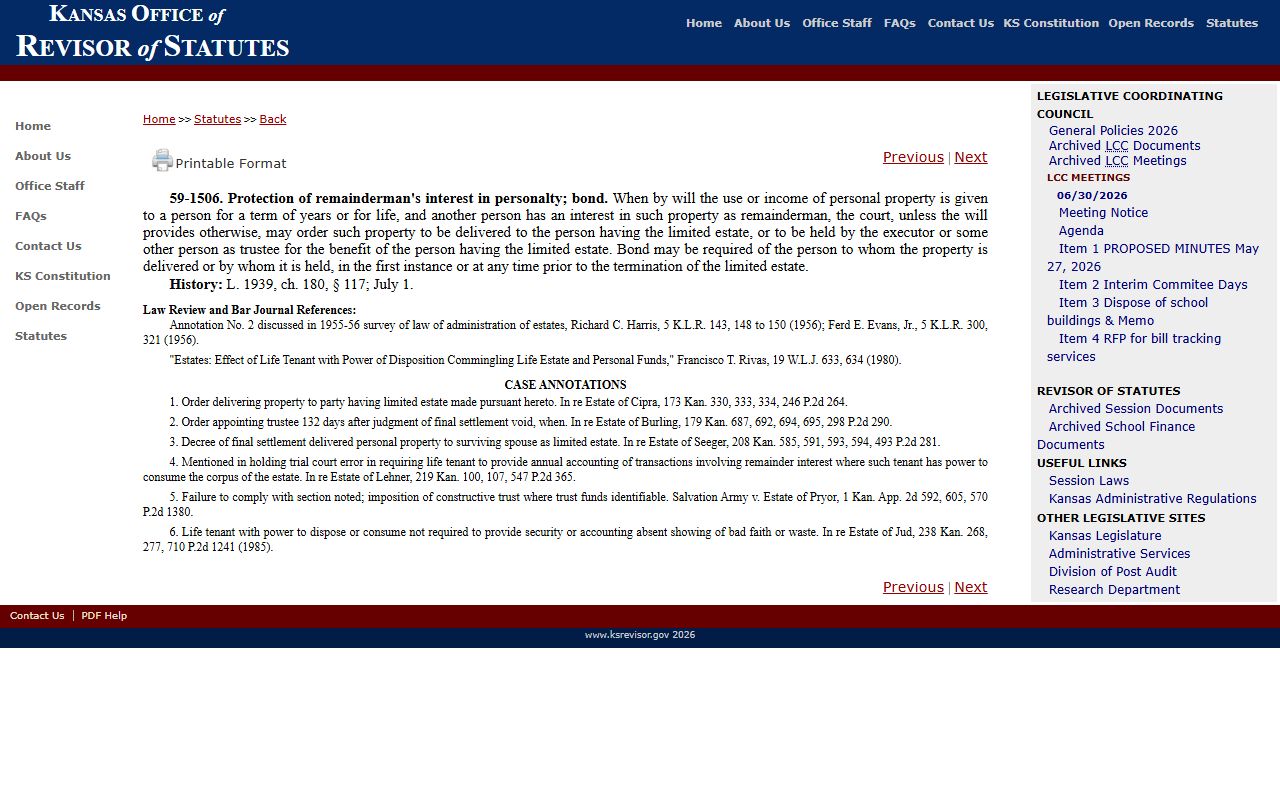
The statute gives legal context, while access to a Riley County probate case still runs through District Court and the Kansas public case-search system.
Riley County Probate Terms
Probate files use terms that are easy to misread. The role named in a will may not be the person the court appoints. A guardian and a conservator do different work. A case caption may name an estate, a minor, or a protected adult rather than the person doing the filing. These definitions help read Riley County probate records without treating every appointment, letter, or report as the same kind of order.
- Testator
- The person who made a will.
- Executor
- The person named in a will or appointed by the court to carry out estate duties.
- Intestate
- A death without a valid will, so estate distribution follows Kansas law and court orders.
- Guardianship
- A court case appointing someone to make personal-care decisions for a minor or incapacitated adult.
- Conservatorship
- A court case appointing someone to manage money or property for a protected person.
- Letters
- Court-issued proof that a fiduciary has authority, such as letters testamentary or letters of administration.
Riley County Probate Case Types
The Riley County probate channel covers more than wills. District Court jurisdiction includes administration of estates, guardianships, conservatorships, and related protective proceedings. The probate file may concern a decedent, a minor, an incapacitated adult, a creditor claim, or a fiduciary's duty to report assets and spending. Trust-related filings may also appear in district court where appropriate.
- Estates and administration of estates after death.
- Wills and petitions to admit a will.
- Intestate estates when no valid will controls.
- Small estates when Kansas law allows a shorter process.
- Guardianships and conservatorships for minors or adults.
- Minor's estate proceedings and adult protective filings.
- Trust-related district-court filings when jurisdiction is proper.
City municipal courts do not act as Riley County probate courts. The City of Riley Municipal Court page, for example, is a local municipal-court source for city matters, not the place to file an estate.
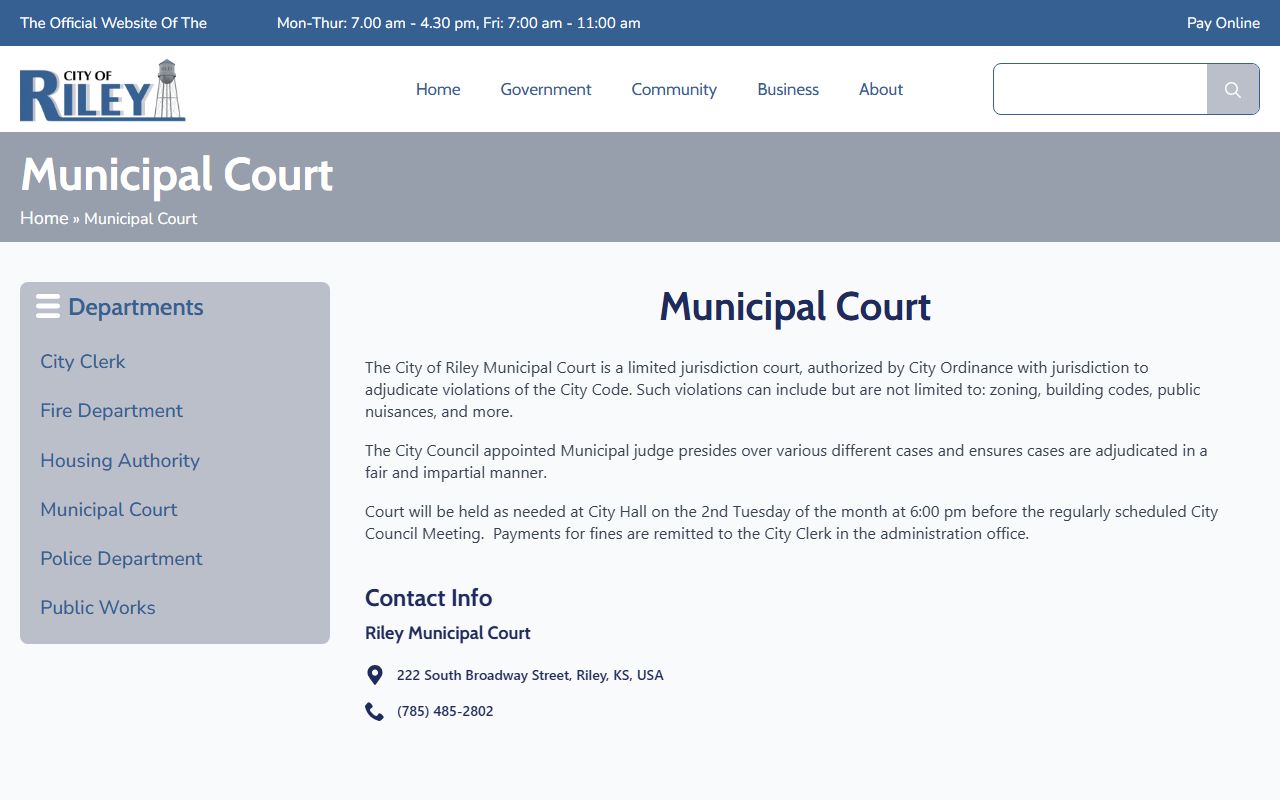
For probate, the correct Riley County route is District Court, not a city municipal court.
Search Riley County Probate Records
Start with the Kansas District Court Public Access Portal when a case number, decedent name, protected person name, or party name is known. The portal may show public probate case index information where the record is not restricted. If the file is older, not digitized, or not visible online, use the courthouse public terminal or contact the Riley County Clerk of the Court. Riley County's public access computers support name and case-number searches, while Kansas courts do not perform searches by phone.
- Search by probate case number if it is known, using the Kansas district-court case format shown by the record.
- If the case number is unknown, search by decedent, protected person, petitioner, guardian, conservator, executor, administrator, heir, or creditor name.
- Use Riley County and 21st Judicial District context to separate local results from similar names in other counties.
- For documents not available online, use the public terminal or ask the Clerk of the Court how to request copies.
- For sealed, redacted, or restricted items, expect a court order or party status requirement before access is granted.
Bankruptcy is not probate, even though both can involve debts, assets, and court files. Federal bankruptcy cases use the U.S. Bankruptcy Court for the District of Kansas.
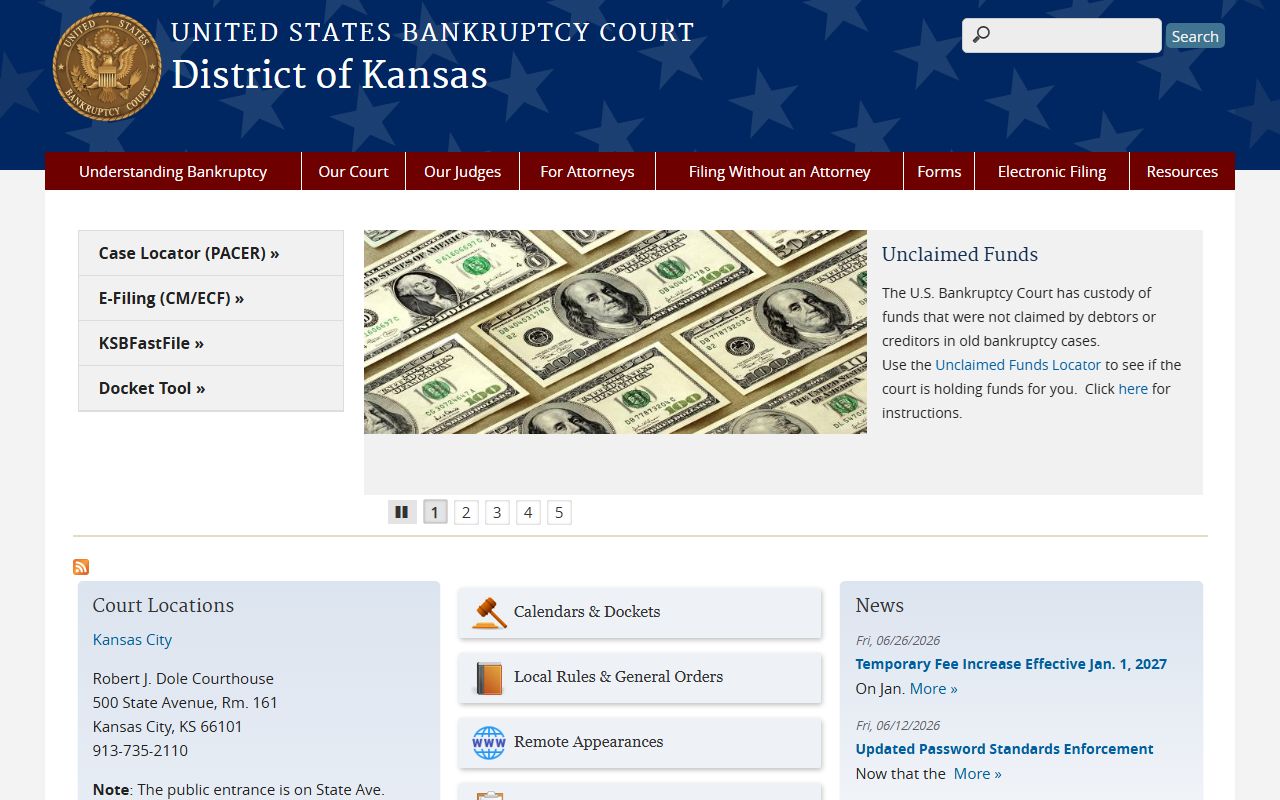
Use federal bankruptcy systems for bankruptcy cases; use Riley County District Court for probate estates and guardianship records.
Riley County Probate Search Fields
The best probate search field depends on the file type. Estate files often follow the decedent's name. Guardianship and conservatorship files may follow the protected person's name. A petitioner, heir, executor, administrator, guardian, conservator, or creditor may appear in the party list, but not every name in a probate file is the lead case name.
| Field Label | Type | Required | Options / Format Notes |
|---|---|---|---|
| Case Number | Text | Optional if searching by name | Use the probate case number if known; statewide formats may include a probate-related type code. |
| Decedent or protected person name | Text | Optional if case number is known | Search by estate name, minor name, or protected adult name. |
| Party name | Text | Optional | Petitioner, executor, administrator, guardian, conservator, heir, or creditor may appear. |
| County or location | Filter/manual | Optional | Use Riley County or 21st Judicial District context to distinguish results. |
Riley County Probate Court
The probate contact is the same courthouse and clerk channel used for Riley County District Court records. The Clerk of the Court is named in the research as Barbara Cragg. The office handles Civil, Criminal, Domestic, Juvenile, Probate, Marriage Licenses, Small Claims, and Traffic. Phone contact is useful for routing and procedure, but not for asking staff to run a name search.
Probate Division of District Court
Clerk: Barbara Cragg, Clerk of the Court
100 Courthouse Plaza
Manhattan, KS 66502
785-537-6364
Fax: 785-537-6382
8:00 a.m.-5:00 p.m., Monday-Friday
For in-person searches, bring the case number if known, the full name of the decedent or protected person, approximate filing dates, and your contact information for copy follow-up. If the request involves a protected person, minor, medical record, or financial account, ask what proof of authority is required before making a trip.
Riley County Probate Fees
Probate filing fees are Kansas district-court fees, not a separate Riley County probate-court price list. The research located Kansas Judicial Branch fee guidance listing Conservatorship at $91.50 and noting other probate filing categories. Riley-specific probate copy fees were not found in the reviewed county pages. Use the statewide fee page for filing amounts, and ask the Clerk of the Court for current plain-copy, certified-copy, and mail charges.
| Item | Amount or Source |
|---|---|
| Conservatorship filing | $91.50 in Kansas Judicial Branch fee guidance located during research |
| Estate or probate filing | Use the current Kansas Judicial Branch district-court fee schedule |
| Guardianship filing | Use the current Kansas Judicial Branch district-court fee schedule |
| Certified probate copy | Ask Riley County Clerk of the Court for current certification and copy charges |
| Mail or fax copy request | Confirm availability, cost, and payment method with the Clerk of the Court |
Note: Fee schedules change, so verify filing and certification charges before mailing probate pleadings or copy requests.
What Riley Probate Files Show
A Riley County probate file can include the caption, petition, will, notices, proof of publication, letters, inventory, accounting, sale orders, hearing notices, and final orders. Guardianship and conservatorship files may include appointment orders, annual reports, accountings, and later review orders. A document called an inventory usually lists assets. An accounting reports money received and spent. Letters are proof of authority, not personal correspondence.
| Record Field | What It Shows |
|---|---|
| Case caption | Estate of a decedent, guardianship of a person, or conservatorship of a person. |
| Petition | Request to admit a will, appoint a fiduciary, or open protective proceedings. |
| Will | Filed or admitted will if public and part of the record. |
| Notices | Notice to creditors, heirs, interested parties, or proposed wards. |
| Letters | Authority for executor, administrator, guardian, or conservator. |
| Orders | Court rulings admitting a will, appointing a fiduciary, approving sale, or closing the case. |
Riley County Probate Process
Probate begins with the type of case. A will filing is not the same as a conservatorship. A small estate does not move like a contested guardianship. The research supports a practical Riley County process: identify the case type, use Kansas Judicial Council or self-help forms if available, file through the District Court probate channel, pay the fee or request waiver, give notice, attend hearings, file required reports, and close the estate or remain under court supervision.
Process flow: Case type identified › Petition prepared › Filing through Clerk of the Court › Fee or waiver › Notice to interested persons › Hearing or order › Inventory, accounting, or reports › Closing order or continued supervision.
Complex estates, disputed wills, contested guardianships, and conservatorships with substantial assets often require legal advice. The clerk can accept filings and provide public access channels, but the clerk cannot choose forms, draft pleadings, or tell a fiduciary how to distribute property.
Restricted Riley Probate Records
Probate is not fully open in every detail. Guardianship, conservatorship, medical, financial, minor, and mental-health information may be redacted or restricted. Some reports may be available only to parties, counsel, fiduciaries, or people with a court order. A public case index may confirm that a probate case exists while withholding images or sensitive documents. That is a normal limit, not a sign the file is missing.
When a restricted probate document is needed, ask the Clerk of the Court what proof of identity, authority, party status, or court order is required. Bring written authority such as letters testamentary, letters of administration, guardianship orders, conservatorship orders, or attorney appearance information when applicable. Requests that involve medical or financial details should be framed as exact document requests, not broad demands for the whole file.